
Curodont in Brighton, CO
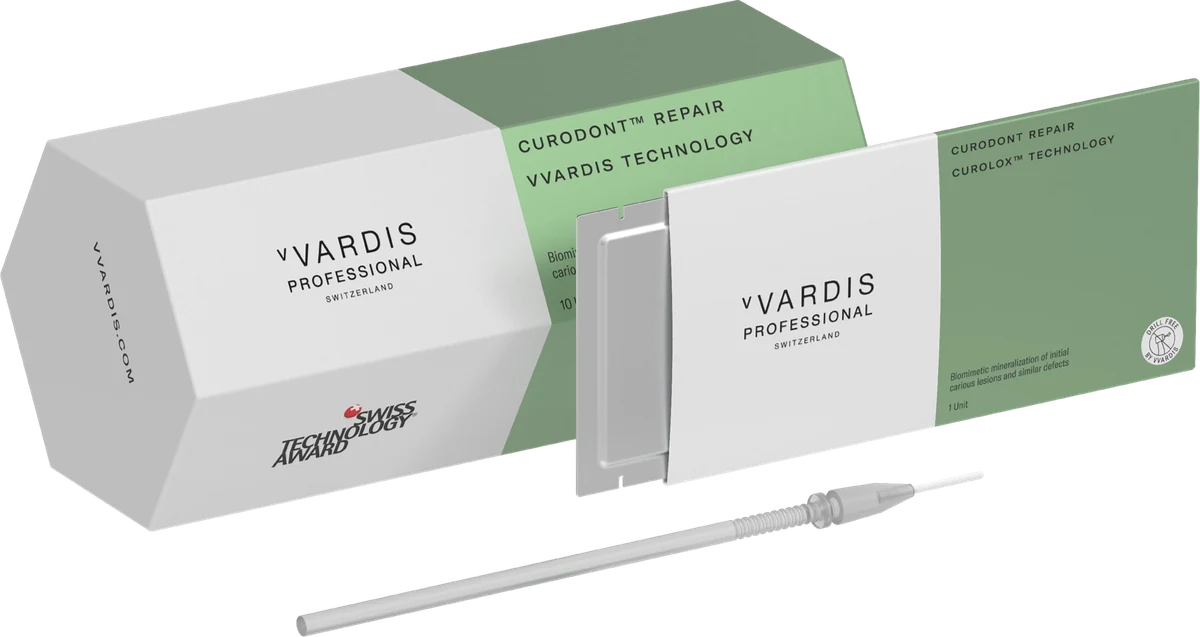
Curodont is a drill-free treatment for early tooth decay: the kind that has started to weaken enamel from the inside but has not yet broken through into a cavity. It is applied in a single short visit, with no drilling and no anesthetic, and it works by rebuilding mineral inside the tooth rather than cutting the damaged part away.
What Curodont Repair Is
What Curodont Treats
Decay does not begin as a hole. It begins as a soft, chalky patch where enamel has lost mineral — what dentists call an early or white-spot lesion. Left alone, that patch keeps losing mineral until the surface collapses and a filling is the only option left. Caught while the surface is still intact, it can go the other way.
Curodont exists for that window. We use it for early lesions found on x-ray between teeth, for the chalky white marks that often show up along the gumline once braces come off, and for patients whose teeth decay faster than brushing alone can keep up with.
You may be a good candidate if
- Your dentist has an early spot they have been watching rather than filling
- You have white marks on your teeth after orthodontic treatment
- An x-ray has shown early decay between two teeth
- Your child or teenager is getting early decay on their molars
- You have dry mouth, or a history of getting cavities easily
What Curodont Cannot Do
This matters as much as the rest of the page, so we would rather say it plainly. Curodont works inside enamel that is still whole. Once decay has broken through the surface and made an actual cavity, nothing painted onto the tooth will fill that hole — it needs a restoration. If we look and find a cavity rather than an early lesion, we will tell you that, and we will talk about a filling or a Solea Laser restoration instead.
It is also not a substitute for brushing, flossing, fluoride or regular hygiene visits. It works alongside them, and it works best for people who keep doing all of the above.
How Curodont Works
The active ingredient is a self-assembling peptide called P11-4. Applied to an early lesion, it soaks into the porous enamel and then assembles itself into a three-dimensional scaffold inside the tooth — a matrix that imitates the natural protein framework enamel is built on in the first place.
That scaffold then attracts calcium and phosphate out of your saliva and guides them into position, so mineral is rebuilt from within the lesion outward. That is the difference from a fluoride varnish, which mainly hardens the outer surface it sits on. The two are complementary, which is why we finish the appointment with fluoride.
 Curodont™ Repair is a vVARDIS Professional product, developed and manufactured in Switzerland.
What to Expect at Your Appointment
- First, we confirm what we are looking at
An exam and x-rays tell us whether the surface is still intact. This is one of the places our AI-powered x-ray review earns its keep — early lesions are exactly the sort of thing that is easy to miss by eye.
- Then we clean and condition the tooth
The surface is polished and briefly conditioned so the peptide can soak in properly. Nothing is drilled and nothing is removed.
- Next, the Curodont goes on
A single dose is mixed and painted onto the lesion with a fine applicator, then left to absorb for a few minutes. Many people feel nothing at all, and no numbing is needed.
- After that, a fluoride varnish
A fluoride varnish goes on top to protect the surface while the mineral rebuilds underneath.
- Finally, we check it at your next visit
Remineralization is not instant — it happens over the following months. We photograph and re-examine the spot at your next hygiene visit to see how it has responded.
What the Research Shows
P11-4 has been studied in controlled trials rather than only marketed. A 2023 systematic review and meta-analysis in the Journal of the American Dental Association pooled the published trials on initial caries lesions and found P11-4 reduced lesion progression compared with control treatment. A 2024 randomized controlled trial comparing P11-4 plus fluoride against fluoride varnish alone reported greater improvement in lesion scores at six months.
That is the state of the evidence, and it is not a promise about your teeth. How well an individual lesion responds depends on how early it was caught, how deep it already is, your diet, your home care and how much saliva you produce. Dr. Schmidt will tell you honestly whether a particular spot is worth treating this way, or whether you are better off with a filling.
How It Compares With the Alternatives
Curodont is not the only option for an early lesion, and it is worth knowing what it is being weighed against.
Watching and waiting
The traditional approach: note the spot, check it at each visit, and fill it if it gets worse. For a lesion that is barely there it can be perfectly reasonable — but it is a strategy of waiting to see whether you need a filling rather than trying to avoid one.
Fluoride varnish
Quick, well proven, and something we apply routinely. It works mainly on the surface of the enamel. For a shallow lesion that is often enough on its own, which is why we do not suggest Curodont for every white spot we find.
Silver diamine fluoride
Very effective at arresting decay, and useful for young children and for patients who cannot easily tolerate treatment. Its drawback is cosmetic: it stains the treated area permanently black, so it is rarely the choice for a front tooth.
Curodont
Works inside the lesion rather than on top of it, and leaves no stain. Coverage varies by plan. It makes most sense for a lesion deep enough that varnish alone is unlikely to turn it around, on a tooth where appearance matters, or in someone who is getting new lesions faster than prevention is keeping up.
Where Curodont Fits With Your Other Care
Curodont is a preventive treatment, so it belongs with the rest of your routine general dentistry rather than replacing any of it. Early lesions are usually found at a checkup, which is the strongest argument for keeping them regular.
It comes up most often after orthodontics — white marks around where brackets sat are one of the most common reasons people ask about it — and in children's dental care, where avoiding a child's first drill is worth a great deal. If a lesion has already gone too far, dental restorations and same-day crowns are the next conversation, not this one.
Ask Us About Curodont
If someone has told you that you have a spot to keep an eye on, bring it up at your next visit and we will look at whether Curodont is an option. If you are a new patient, mention it when you book and we will make sure there is time to check properly.
Common questions
Does Curodont hurt?
No. Nothing is drilled and nothing is removed, so there's no need for numbing. The tooth is polished, the treatment is painted on, and it soaks in over a few minutes. Many people say it feels like having a fluoride varnish done.
How long does the appointment take?
The treatment itself takes only a few minutes per tooth, and it's usually added to a visit you're already having. If you're coming in specifically for it, allow about half an hour so we can examine and x-ray properly first.
Does Curodont replace a filling?
Not once you actually have a cavity. It works on early decay where the enamel surface is still intact — if the surface has already broken down, the tooth needs a restoration and we'll tell you so rather than treat it with something that can't work.
Is it safe for children?
It's used in children and teenagers, and early molar decay and post-braces white marks are two of the most common reasons for it. As with any treatment, we'll go through it with you and your child before starting.
Will my insurance cover it?
Coverage for newer preventive treatments varies a lot between plans, and many don't have a code for it yet. We'll verify your benefits and tell you the cost before anything is done — never after.
How will I know whether it worked?
Remineralization happens over months, not days, so we photograph and re-examine the spot at your next hygiene visit and compare. If it hasn't responded, we'll say so and talk about what to do next.
Ready to talk about curodont?
Call our Brighton office at (303) 659-5185 or request an appointment online — we'll find a time that works for you.
Book Now